Ambient layer
Recessed downlights provide overall illumination — typical kitchen 8–14 downlights at 1.5m spacing in a grid. Use 3,000K colour temperature (warm-neutral) — 4,000K reads as clinical, 2,700K too yellow for prep. CRI 90+ for accurate food/skin tones. Beam angle 60° (avoid 36° spots — create harsh shadows). 8W LED per fitting typical. Position downlights over the front edge of worktops (450mm from wall) — not centred — so light falls onto worktop not just floor. Dimmable on a single circuit for the ambient layer. Avoid the 'runway lights' pattern (single straight row); aim for a balanced grid.
Task layer
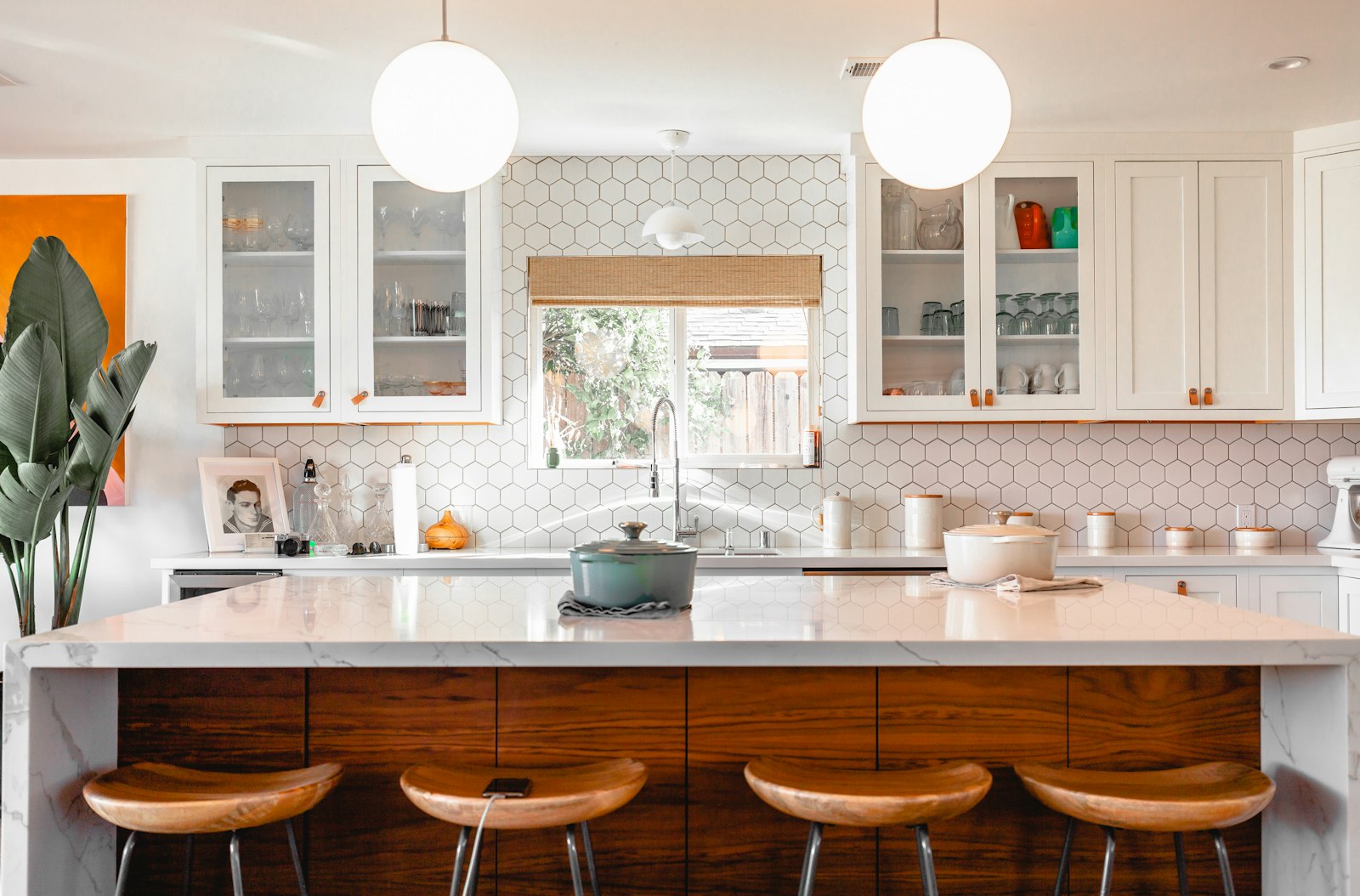
Under-cabinet LED strip: 24V, 800–1,200 lumens/metre, 3,000K, CRI 90+, mounted in extruded aluminium channel under wall units, behind 8mm diffuser. Critical because the cook's body shadows worktops when overhead lighting is sole source — under-cabinet eliminates shadow. £85–£185/m supplied and installed. Island pendants: 1–3 pendants at 700mm above island, 12W LED each, 3,000K, dimmable. Pendants double as task + feature (lighting designer pendants are sculptural). Hob: ensure cooker hood has integrated task light at 350 lux on hob surface. Sink: dedicated downlight directly above sink, switched separately for early-morning use without full ambient.
Accent and feature layers
Accent: in-cabinet shelf lighting (8W LED strip on top edge of glass-fronted cabinets, washing down through glass shelves and contents), plinth light (low-level 1.8W LED strip at floor level wraps base of cabinets, creating 'floating' effect — switched separately, low-level use for night), top-of-cabinet uplighting (LED strip behind moulding washing ceiling — extends ceiling visually). Accent layer not for tasks — purely for atmosphere and depth. Feature: statement pendant or chandelier over dining table within open-plan kitchen — visual anchor for the room, 3,000K, dimmable, scaled to the table (pendant width 1/3 of table length). Avoid too-many statement pieces — one feature pendant + one or two island pendants is enough.